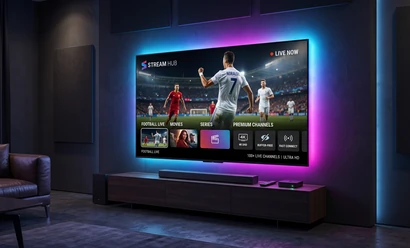
IPTV in Germany: Setup, Internet and Turkish Broadcasts



Euro Prime TV Editorial Team
Using IPTV in Germany is directly affected by the country's internet infrastructure and home network layout. In areas with fibre, cable and DSL lines the stream quality is noticeably higher; at addresses with older infrastructure a quality limit may be necessary. The only condition for accessing Turkish broadcasts is having a sufficient and stable internet connection.
In this guide we cover IPTV use in Germany under the headings of connection, device, setup and troubleshooting.
What is the internet infrastructure like in Germany?
In Germany a large proportion of households are served by DSL, cable or fibre lines. Fibre and cable are common in city centres; in rural areas the speed can drop because of distance. What matters is not the nominal speed of the line but the real speed measured in the evening.
-
Fibre: the most stable option, an advantage at high resolution.
-
Cable: may fluctuate at busy hours because of shared capacity.
-
DSL: sensitive to distance, speed varies from address to address.
-
Mobile: suitable for short-term use, the data package is limited.
Which connection speed is enough?
The speed needed for the stream varies with the resolution being watched. If several screens are used in the same home the speed requirement adds up. That is why package selection should consider simultaneous use at home rather than a single screen.
| Resolution | Single screen | Two screens |
|---|---|---|
| SD (480p) | 3 Mbps | 6 Mbps |
| HD (720p) | 5 Mbps | 10 Mbps |
| Full HD (1080p) | 8 Mbps | 16 Mbps |
| 4K (2160p) | 25 Mbps | 50 Mbps |
| The figures vary with the bitrate of the stream; details in the what is bitrate in IPTV article. |
Ways to access Turkish broadcasts
In Germany Turkish broadcasts are watched in two main ways: satellite infrastructure and internet-based streaming. Satellite requires a dish installation and is tied to a fixed place; internet-based viewing makes it possible to use the same subscription on phone, tablet and television. The comparison of the methods is in the how to watch Turkish channels in Europe article.
-
Satellite: fixed installation, the channel list is determined by the broadcaster.
-
Internet: flexible number of devices, use is not tied to a place.
-
Combination: some households use both methods together.
-
Rights: broadcast rights differ by country; the broadcaster's terms apply to content access.

Device and app choice
The common devices in Germany are smart televisions, media players and mobile devices. If there is more than one screen at home, device compatibility and the simultaneous viewing allowance should be planned in advance. Device selection criteria are explained in the How to choose an IPTV player article, and the setup steps in the Smart TV setup articles.
Setup steps
Setup in Germany follows the same order as in other countries: preparing the device, installing the player, entering the login details and testing the stream. If no suitable player is found in the device store, alternatives that support the playlist address are considered.
| Step | Action taken | Check |
|---|---|---|
| 1 | Speed test | Is the measured speed sufficient |
| 2 | Player setup | Does the app open |
| 3 | Login details | Does the playlist load without errors |
| 4 | Channel test | Does the stream play smoothly |
| 5 | Screen test | Does it work on other devices too |
Common problems in Germany
The most common problems in German households are fluctuation caused by the wireless network and codec incompatibility on older devices. Other uses sharing the line at busy hours affect the stream too.
-
Fluctuation: if the speed drops in the evening a wired connection is needed.
-
Codec: high-resolution streams may not open on older devices.
-
Playlist: an error in the login details is a common cause; details in the playlist not loading article.
-
App: versions that are not up to date can close unexpectedly.
Broadcast rights and terms of use
Broadcast rights are regulated country by country; whether a piece of content can be watched in Germany depends on the rights scope of the broadcaster. When taking a service, the provider should be expected to share the scope and terms transparently. The user should take the subscription terms and the legal framework of the country they are in into account.
-
Scope: which channel and catalogue groups are included should be stated.
-
Terms: the period of use and the device allowance should be in writing.
-
Support: the contact channel and response time should be known.
-
Comparison: package criteria are covered in the one device or multiple devices article.

Frequently asked questions
What speed is needed for IPTV in Germany?
Around 8 Mbps is enough for Full HD and around 25 Mbps for 4K; as the number of simultaneous screens rises the requirement adds up.
In Germany, is satellite or internet more suitable?
For those who want a fixed setup satellite is more suitable, while internet-based viewing suits those who want portability and several devices.
Why does my stream stall in Germany?
The most common cause is the home wireless network. Test with a wired connection and a quality limit.
How do broadcast rights work in Germany?
Rights are regulated country by country and depend on the broadcaster's scope; the subscription terms should be reviewed.
Sources
Official sources have been consulted for the technical statements in this article: Bundesnetzagentur – Telecommunications regulatory authority, ITU-T Y.1901 – Requirements for the support of IPTV services. These sources explain how broadcast technology generally works; for service scope and device support, see the relevant package and support pages.
Tags: